



Last Updated: October 28, 2026
Quick Summary
Help your child with maths anxiety by calming the body first, using slow breathing or a short stretch before opening the book, then reframing negative beliefs with believable affirmations like I can’t do this yet. Build confidence through ten minutes of daily maths talk and low-stakes games, and manage your own reactions too.
- Watch for stomach aches, tears, or saying I’m stupid before maths homework starts.
- Try four counts in and six counts out, five times, to calm before maths.
- Ten minutes a day of maths talk, not worksheets, helps build real confidence.
- Avoid timed drill apps, which a 2023 review linked to higher cortisol in anxious children.
- Check your own tension before homework and delay the session if you are rushed.
Table of Contents
- Why Maths Anxiety Happens and Why It Isn’t Just ‘Not Being Good at Maths’
- Signs of Maths Anxiety in Children: What to Watch For at Home
- Maths anxiety coping strategies for kids you can start today
- How to Build Maths Confidence in Children Through Daily Habits
- Maths Games and Activities for Anxious Children That Don’t Feel Like Maths
- When Maths Anxiety Overlaps with Dyscalculia or Other Learning Differences
- How to Reduce Test-Taking Anxiety and Performance Pressure
- Book a Diagnostic Assessment with Naijatutors Konnect
- Frequently Asked Questions
Why Maths Anxiety Happens and Why It Isn’t Just ‘Not Being Good at Maths’
Maths anxiety is a genuine emotional response to numbers, not a sign that your child is lazy or simply “bad at maths (What is maths anxiety?).” It shows up as a real stress reaction, and it can affect any child at any age.
At Naijatutors Konnect, we provide personalized, live online tutoring for children aged 4 to 16.
The UK’s National Numeracy charity describes this as a learned emotional block, not a lack of ability. The brain reads a maths problem as a threat. Working memory shuts down. The child goes blank.
So how do you help a child with maths anxiety? Below are some ideas to consider at home.
Signs of Maths Anxiety in Children: What to Watch For at Home
Some children may show physical or behavioural signs of distress around maths. Consider more than just wrong answers.
Common signs include:
- Stomach aches or headaches before maths lessons
- Tears, anger, or silence when homework starts
- Saying “I’m stupid” or “I can’t do maths” before trying
- Rushing through work to get it over with
- Avoiding maths talk entirely, even about money or time
If your child shows several of these signs, consider changing your approach rather than pushing harder.
Maths anxiety coping strategies for kids you can start today
Here are two kinds of coping strategies you could try.
Calming the Body First: Physical Regulation Techniques
If your child feels stressed, you could try a calming activity before opening the book.
Try these physical techniques:
- Slow breathing: Four counts in, six counts out, five times.
- Grounding: Name five things your child can see and three they can touch.
- Movement: A two-minute stretch or walk before starting.
- Water break: A cold drink can reset a tense moment.
- Shake it out: Shake hands and shoulders for ten seconds to release tension.
Reframing Negative Beliefs with Positive Affirmations
You could try a specific, believable affirmation, such as “I’m still learning this.”
Try these swaps:
- “I can’t do this” becomes “I can’t do this yet.”
- “I’m stupid” becomes “My brain grows when I try.”
- “Maths is impossible” becomes “This part is tricky, and I can get help.”
You could say them out loud together.
These are the physical calming techniques the article suggests trying before opening the maths book.
| Technique | What to do |
|---|---|
| Slow breathing | Four counts in, six counts out, five times |
| Grounding | Name five things seen and three things touchable |
| Movement | A two-minute stretch or walk before starting |
| Water break | A cold drink can reset a tense moment |
| Shake it out | Shake hands and shoulders for ten seconds |
How to Build Maths Confidence in Children Through Daily Habits
Short, regular habits are one approach to building maths confidence. You can also consider how you manage your own reactions.
Daily Habits That Build Real Confidence
Try these habits:
- Ten minutes a day of maths talk, not worksheets
- Real-life numbers: counting change, reading prices, measuring for cooking
- Let your child explain a sum back to you, teaching is the best test
- Praise effort and method, not just the right answer
- Keep a “wins” list of problems they cracked last week
For more practical routines, see our guide on effective study techniques for children.
Parental Self-Regulation: Managing Your Own Maths Baggage
Try these strategies:
-
Notice your body first. When your child asks a maths question, check your own shoulders, jaw, and breathing. If you are tense, pause before responding.
-
Use a neutral script. Instead of “I was never good at this,” say “Let’s figure this out together.”
-
Model the reset. If you feel frustrated, say out loud: “I’m feeling stuck. I’m going to take a breath and try again.”
-
Avoid the “maths gene” myth. Never say “some people are just born bad at maths.”
Before a homework session, take thirty seconds to check your own state. If you are rushed, tired, or anxious, you could delay the session.
If a question stumps you, you could say: “I don’t know, but we can find out.”
Maths Games and Activities for Anxious Children That Don’t Feel Like Maths
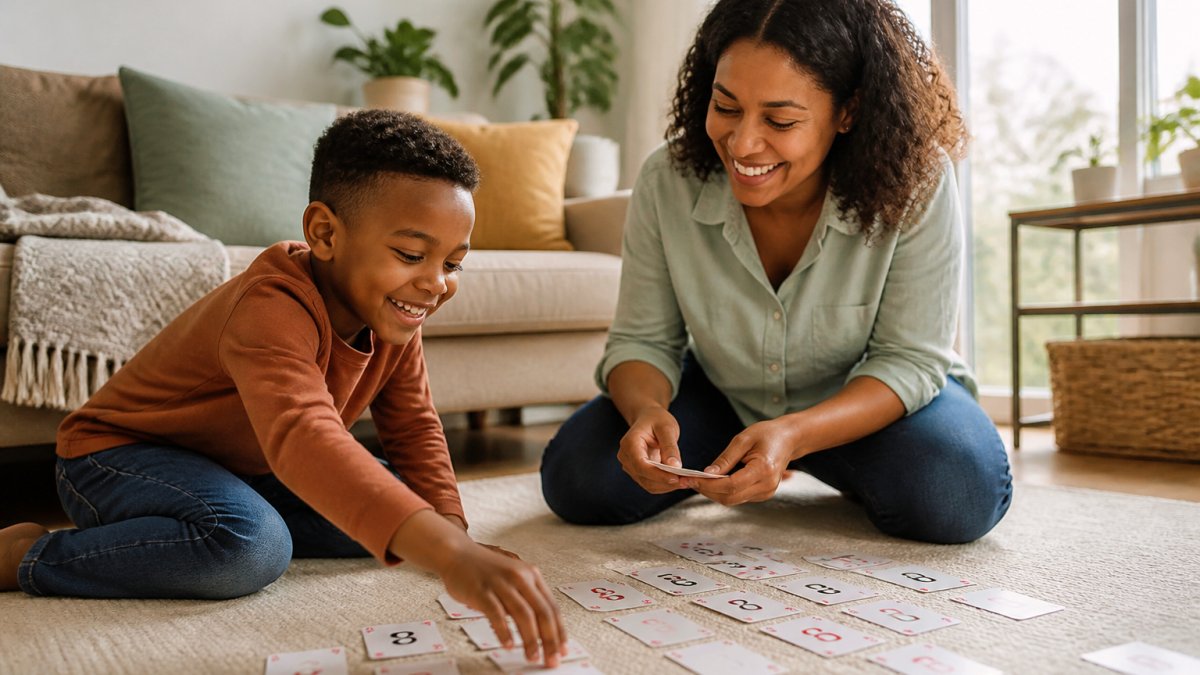
Maths games and activities for anxious children can be approached as play rather than testing. You could focus on making the activity enjoyable.
Low-Stakes Games That Build Number Comfort
You could start with games that have no timer, scoreboard, or audience.
Try these:
- Card games that use number skills, like making ten (e.g., pairs that add to 10)
- Board games with dice and counting, played at a relaxed pace
- Cooking together, measuring and doubling recipes, real fractions without the worksheet
- Shopping games, adding prices and counting change
- Number hunts around the house or street (find five things that are round, count the stairs, etc.)
Keep it light, and stop while your child is still enjoying it. If you catch yourself quizzing, you could pause.
The Hidden Trap: Timed and Gamified Maths Apps
A 2023 review of educational technology found that timed drill apps can increase cortisol levels in children who already show maths anxiety. The app feels like a game, but the child’s brain reads it as a test.
Digital Tool Safety and Screen-Time Balance
If you use digital maths games, you could set a timer and play alongside your child.
You could check a game’s settings and keep sessions short.
If your child asks to stop, you could stop the activity.
When to Choose Analog Over Digital
Once your child is comfortable with low-stakes analog play, you can introduce a carefully chosen digital tool, but only if it has no timers, no leaderboards, and no public comparison. The goal is to build positive associations with numbers, not to add another source of pressure.
When Maths Anxiety Overlaps with Dyscalculia or Other Learning Differences
You can understand exactly where your child needs support before deciding on next steps.
How to Reduce Test-Taking Anxiety and Performance Pressure
You could try low-stakes practice and focus on the process rather than the score.
Try this:
- Practice under calm conditions first, then add mild time limits
Book a Diagnostic Assessment with Naijatutors Konnect
An initial diagnosis can help inform a personalized learning plan.
At Naijatutors Konnect, expert Nigerian tutors provide personalized learning plans based on an initial diagnosis. Live, interactive sessions and flexible scheduling across time zones are available for families in the UK, US, Canada, and beyond.
Check our maths tutoring options. You can also review prices before you commit. Ready to talk it through? Let’s talk about your child’s learning journey.
Frequently Asked Questions
How can I tell if my child has maths anxiety or is just struggling with the subject?
Some children may show signs of distress around maths, such as avoidance, frustration, or negative self-talk. If you are concerned, consider discussing your child’s needs with a qualified professional.
Can maths tutoring actually help a child with maths anxiety?
Naijatutors Konnect provides personalized, live online tutoring for children aged 4-16, with learning plans based on an initial diagnosis. The approach prioritizes measurable progress and a supportive learning environment.
What can I say to a child who is afraid of maths?
You could acknowledge your child’s feelings and offer to work through a question together. For example: ‘Maths feels hard right now, and that’s okay’ or ‘Let’s figure this out together.’
How can I make maths practice less stressful at home?
You could try short practice sessions and use games, cooking, shopping, or board games to practise numeracy. If homework regularly causes distress, consider discussing your concerns with your child’s school.
Maths anxiety is real, and it does not have to define your child’s future. With the right support, most children can rebuild confidence and start to enjoy numbers again. Naijatutors Konnect offers diagnostic-led planning, expert tutors, and live sessions built around your child’s needs. Get started with Naijatutors Konnect and help your child feel calm, capable, and confident with maths.

